

History of St Andrews
A History of St. Andrews: From Ancient Shores to the Salty Soul of Panama City
St. Andrews didn’t just happen. It grew slowly, stubbornly, and with the kind of character only a waterfront town can carve out of salt air, hard work, and a little mischief. Long before boutiques, tap rooms, and live music spilled onto Beck Avenue, this place had already lived more lives than most coastal towns ever dream of.
Before Europeans: 13,000 Years of Native Roots on the Bay
St. Andrews has been an excellent place to live for as long as people have lived in the Americas. Artifacts found along the shoreline show that Native Americans were here at least 13,000 years ago, adapting their cultures to changing climate, rising and falling seas, and shifting food sources. Shell middens tell the story of generations who gathered oysters and shellfish from the same waters that define the community today.
By the time the Spanish arrived around 1500, the Chatot and Yuchi tribes inhabited the St. Andrews Bay region. Within decades, the Chatot—like more than 90% of Florida’s Native peoples—were gone due to disease and conflict. The Yuchi survived by dispersing north and west, and the bay slowly repopulated around 1700 by Creeks and Cherokees who had evaded forced removal. These communities formed part of what later became known as the Seminoles.
Today, their presence still echoes in the landscape: ancient paths that became wagon roads, then city streets; shell mounds hidden behind modern buildings; and place-names that quietly remember who came first.
Early Settlement: Salt, Sea Baths, and a Frontier Life
The first permanent European-American settlement formed along what is now Beach Drive, between Frankford Avenue and Lake Caroline, in an area known as Old Town or St. Andrews City. Retired Georgia governor John Clark and his wife, Nancy, built a home there in 1827. After their deaths in 1832, their home became a boarding house called The Tavern, hosting visitors seeking fresh air, fishing, and the famous “healthy sea baths.”
In the early 1800s, only a few families stayed year-round, carving out a living from the bay. Everything depended on the water—fish, oysters, and the commodity that quietly powered the early Gulf Coast economy: salt.
Salt preserved food, supplied regional markets, and supported the Confederate war effort during the Civil War, making St. Andrews a strategic target. Federal raids repeatedly struck the community, and in 1863, the town was burned and largely destroyed.
But even total destruction didn’t end St. Andrews. It simply rebuilt itself—another theme that would repeat through the centuries.
By the mid-1800s, the summer population swelled to 1,200–1,500, and by 1845, the post office officially called the place “St. Andrews.” The first U.S. geodetic survey in 1855 labeled the town “St. Andrews City” and the waterway “St. Andrews Bay.” When the post office accidentally dropped the “s” in 1902, it wasn’t corrected, resulting in a century of mismatched spellings that locals continued ignoring.
The Ware Brothers and a True Port Town
Modern St. Andrews owes much to brothers Lambert and Francis Ware. Lambert visited in 1877 and returned in 1879; Francis followed in 1882. Together, they built Ware’s Wharf and Ware Mercantile—the beating heart of the new port town. Their wharf became a hub of Gulf Coast commerce, linking Mobile, Apalachicola, and points beyond.
The crown jewel of that era was the SS Tarpon, a dependable passenger and freight steamer whose clockwork arrivals and departures were so reliable that locals joked you could “set your watch by her.” She brought beer, flour, furniture, supplies, and passengers. Her over-loaded push through a storm in 1937 led to her sinking off Panama City Beach, and the wreck is now an underwater archaeological preserve.
Land Boomers, Real Estate Schemes & the Cincinnati Company
As the town grew, outside investors took notice. The St. Andrews Bay Railroad, Land & Mining Company, commonly called the Cincinnati Company, launched a national mail-order land promotion in the late 1800s. They advertised St. Andrews as:
“The loveliest location in all Florida… the brightest jewel the sun ever blessed with its genial kiss.”
Lots measuring 25 by 82 feet sold for $1.25 at first, later rising to $8 in the famed “St. Andrews by the Sea” development. The scheme eventually collapsed, but many of those who came stayed—and St. Andrews gained a new population of settlers who fell in love with the bay.
A Northern Visionary: George M. West
In 1887, George Mortimer West, a Michigan railroad man, bought a home in St. Andrews. He befriended local Creek fisherman Narcisco “Hawk” Massalina, who taught him to navigate the bay. When the U.S. took control of the Panama Canal project in 1904, West envisioned St. Andrews Bay as a southern gateway for global shipping.
West left his railroad career, founded the Gulf Coast Development Company, acquired land that would become downtown Panama City, and partnered with A.B. Steele to build the last 64 miles of railroad into the region. Through his influence, West built:
the first city dock
the first Panama City School
the first Panama City Bank
early parks and churches
the courthouse
For these contributions, West is considered a founding father of Panama City.
1908: St. Andrews Incorporates
By 1908, St. Andrews officially incorporated as a town. The waterfront filled with wooden homes, wharves, fish houses, and shops. Boats packed the marina. Streets buzzed with merchants, fishermen, and vacationers.
St. Andrews was firmly on the map.
1927: Swallowed by the New City of Panama City
In 1927, Panama City annexed St. Andrews, Millville, and two nearby towns. On paper, St. Andrews lost its independence. In spirit, it didn’t lose a thing.
Its character remained intact.
Mid-Century Boom: The Fishing Fleet Era
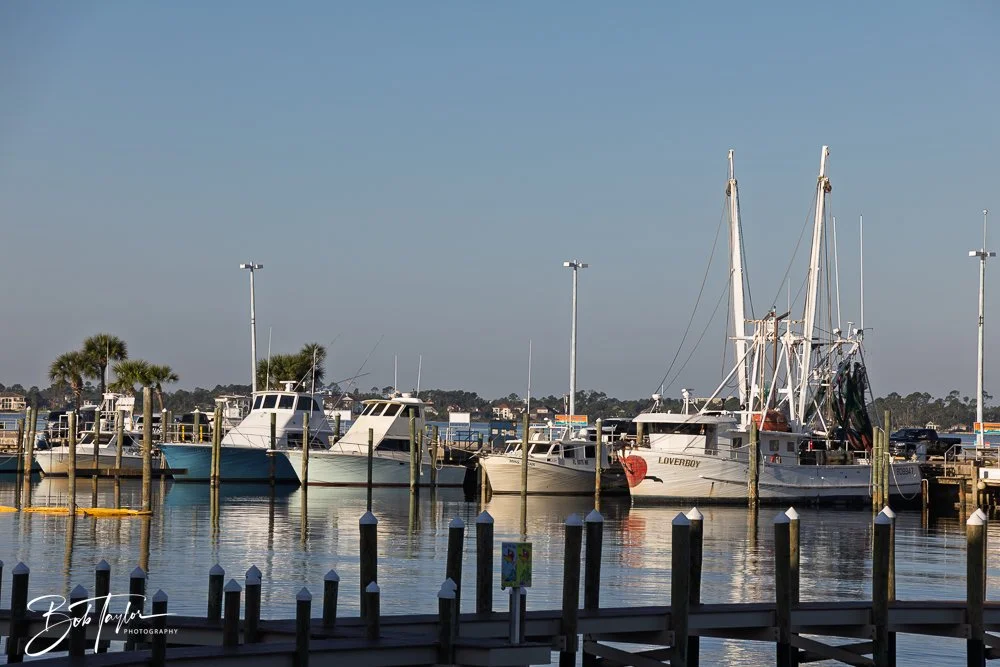
From the 1940s through the 1960s, St. Andrews thrived. The marina overflowed with fishing boats. Crowds packed the docks. Coolers clattered open. Charter captains barked through the din. Fish houses hummed from dawn to dusk.
Restaurants and attractions became Gulf Coast fixtures:
The Shrimp Boat
Mattie’s Tavern
Windham’s Fish & Ice
St. Andrews was, once again, a destination.
World War II deepened its role: the Wainwright Shipyard (today’s Port Panama City) built 33 Liberty Ships, and nearby Tyndall Field drew servicemen—among them actor Clark Gable, who frequented local restaurants.
1980s: A Hard Fall
But when Panama City Beach boomed in the 1980s, businesses drifted across the bridge. Shops closed. The marina declined. For a while, the old neighborhood seemed forgotten.
This is when the modern meaning of “Salty” began to take shape. St. Andrews wasn’t shiny—but it was real. And real tends to survive.
1990s–2000s: A Grassroots Revival
Revival didn’t come from big investors. It came from locals—entrepreneurs, artists, restaurateurs, and community leaders. In 1989, St. Andrews became a Community Redevelopment Area, and in 1997 it joined the inaugural Waterfronts Florida Program. Grants, planning, and grassroots energy rebuilt the bones of the neighborhood.
The historic Panama City Publishing Company building was restored. Independent shops, cafés, markets, and galleries reclaimed old spaces. Festivals returned. Live music spilled into the streets.
By the early 2000s, St. Andrews was once again a walkable, vibrant waterfront village.
2018: Hurricane Michael — A Knockdown, Not a Knockout
Hurricane Michael devastated St. Andrews in 2018. Buildings collapsed. Boats sank. The marina was destroyed. But the community rallied—neighbors helping neighbors, businesses rebuilding, and residents refusing to let the place fade.
The marina is still being redeveloped today, dock by dock, with long-term plans finally gaining momentum.
How St. Andrews Became “Salty”
“Salty” isn’t a branding term. It’s the result of centuries of survival.
St. Andrews is salty because:
Its earliest residents harvested salt from seawater.
Fishermen, boatbuilders, and captains shaped its economy.
The town was burned in the Civil War—and rebuilt.
Hurricanes knocked it down—and it stood back up.
Speculators came and went—but locals stayed.
Beachside development distracted the region—but St. Andrews kept its soul.
The community chose independence, creativity, and authenticity over franchises.
Salty means weathered, resilient, and proud.
Salty means community over corporations.
Salty means knowing who you are—and staying that way.
Today: A Waterfront Village With a Past Worth Protecting
Modern St. Andrews is writing its next chapter. The marina is being rebuilt. Historic buildings are being restored. Local shops, musicians, restaurants, and artists define the streetscape. Festivals fill the year. And the spirit of independence remains as strong as ever.
It is one of the last places on the Gulf Coast where you can watch shrimp boats roll in, hear a guitar from a porch bar, and buy a piece of handcrafted art, all within a three-block walk.
St. Andrews earned every bit of its soul the hard way.
And that, more than anything, is why it remains Salty.